


The third and final course in the CCNA series — master enterprise network design, security, WAN technologies, and network automation to complete your path to CCNA certification.
CCNA: Enterprise Networking, Security, and Automation describes the architectures and considerations related to designing, securing, operating, and troubleshooting enterprise networks. This course covers wide area network (WAN) technologies and quality of service (QoS) mechanisms used for secure remote access. It also introduces software-defined networking, virtualization, and automation concepts that support the digitalization of networks. Students gain skills to configure and troubleshoot enterprise networks, identify and protect against cybersecurity threats, and learn key concepts of software-defined networking including controller-based architectures and how APIs enable network automation.
Curriculum Chapters
- 1. Single-Area OSPFv2 Concepts
- 2. Single-Area OSPFv2 Configuration
- 3. Network Security Concepts
- 4. ACL Concepts
- 5. ACLs for IPv4 Configuration
- 6. NAT for IPv4
- 7. WAN Concepts
- 8. VPN and IPsec Concepts
- 9. QoS Concepts
- 10. Network Management
- 11. Network Design
- 12. Network Troubleshooting
- 13. Network Virtualization
- 14. Network Automation
Skills You Will Learn
Configure and verify single-area OSPFv2 in point-to-point and multiaccess networks. Explain cybersecurity threats, vulnerabilities, and network attack mitigation techniques. Implement standard and extended IPv4 ACLs to filter traffic and secure administrative access. Configure static NAT, dynamic NAT, and PAT on edge routers. Compare WAN connectivity options including traditional, modern, and internet-based technologies. Explain VPN and IPsec concepts for secure remote access. Implement QoS mechanisms for voice, video, and data traffic. Use CDP, LLDP, NTP, SNMP, and Syslog for network management. Explain network virtualization, cloud computing, and software-defined networking. Implement network automation using RESTful APIs, JSON/YAML/XML, and configuration management tools such as Ansible, Puppet, Chef, and SaltStack.
Technologies Used
Cisco Packet Tracer 8.0+
Cisco IOS CLI (Routers & Switches)
Cisco DNA Center
Wireshark
Network Reference Models (OSI / TCP-IP)
Course Details
Course Type: Instructor-led
Time: 70 Hours
Modules: 14
Labs: Hands-on labs & Cisco Packet Tracer activities
Prerequisites
CCNA: Introduction to Networks and CCNA: Switching, Routing, and Wireless Essentials (both required).
Certification & Career
Career and Certification alignment: This is the third and final course in the Cisco CCNA curriculum. Upon completing all three courses, learners are fully prepared to take the Cisco Certified Network Associate (CCNA) certification exam. The course supports career roles such as Network Engineer, Network Administrator, and Network Security Specialist.
Achievements & Badges
Upon completion, earn a Cisco Networking Academy digital badge. Share your verified achievement on LinkedIn, your CV, or professional profile.
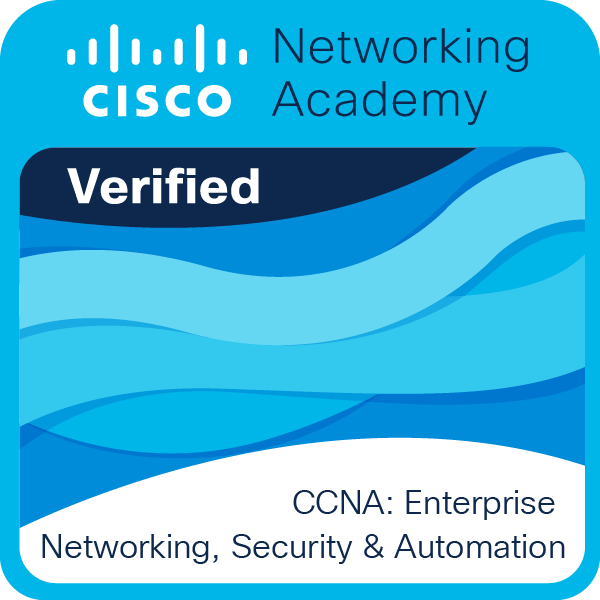
What Cisco verifies: Cisco verifies the earner of this badge successfully completed the CCNA: Enterprise Networking, Security, and Automation course and achieved this student level credential. Earner can configure and troubleshoot single-area OSPFv2, implement IPv4 ACLs and NAT, explain WAN and VPN technologies, apply QoS mechanisms, manage enterprise networks using industry-standard protocols and tools, and demonstrate foundational knowledge of network virtualization and automation.