


The first course in the 3-part CCNA series — explore network architectures, protocols, IP addressing, and Ethernet fundamentals to build your first local area networks.
CCNA: Introduction to Networks introduces the architectures, models, protocols, and networking elements that connect users, devices, applications, and data through the internet and across modern computer networks. By the end of the course, students can build simple local area networks (LANs) that integrate IP addressing schemes and foundational network security, and perform basic configurations for routers and switches. The course emphasizes critical thinking, problem solving, and hands-on practical experience using Cisco Packet Tracer and physical lab equipment.
Curriculum Chapters
- 1. Networking Today
- 2. Basic Switch and End Device Configuration
- 3. Protocols and Models
- 4. Physical Layer
- 5. Number Systems
- 6. Data Link Layer
- 7. Ethernet Switching
- 8. Network Layer
- 9. Address Resolution
- 10. Basic Router Configuration
- 11. IPv4 Addressing
- 12. IPv6 Addressing
- 13. ICMP
- 14. Transport Layer
- 15. Application Layer
- 16. Network Security Fundamentals
- 17. Build a Small Network
Skills You Will Learn
Explain how modern networks and the internet operate. Configure basic settings on Cisco switches, routers, and end devices using the IOS CLI. Understand and apply the OSI and TCP/IP reference models. Work with physical layer media including copper, fiber, and wireless. Calculate IPv4 subnetting schemes including VLSM. Implement static and dynamic IPv6 addressing. Use ARP, ICMP, ping, and traceroute to verify and troubleshoot connectivity. Explain TCP and UDP transport layer operations. Apply foundational network security and device hardening techniques. Build and troubleshoot a small network.
Technologies Used
Cisco Packet Tracer 8.0+
Cisco IOS CLI (Routers & Switches)
Wireshark
Network Reference Models (OSI / TCP-IP)
Course Details
Course Type: Instructor-led
Time: 70 Hours
Modules: 17
Labs: Hands-on labs & Cisco Packet Tracer activities
Prerequisites
Basic computer literacy and internet browsing skills.
Certification & Career
Career and Certification alignment: This is the first of three courses in the Cisco CCNA curriculum. Upon completing all three courses, learners are prepared to take the Cisco Certified Network Associate (CCNA) certification exam. The course supports entry-level roles such as Network Technician, Network Support Engineer, and IT Support Specialist. The recommended next course is CCNA: Switching, Routing, and Wireless Essentials.
Achievements & Badges
Upon completion, earn a Cisco Networking Academy digital badge. Share your verified achievement on LinkedIn, your CV, or professional profile.
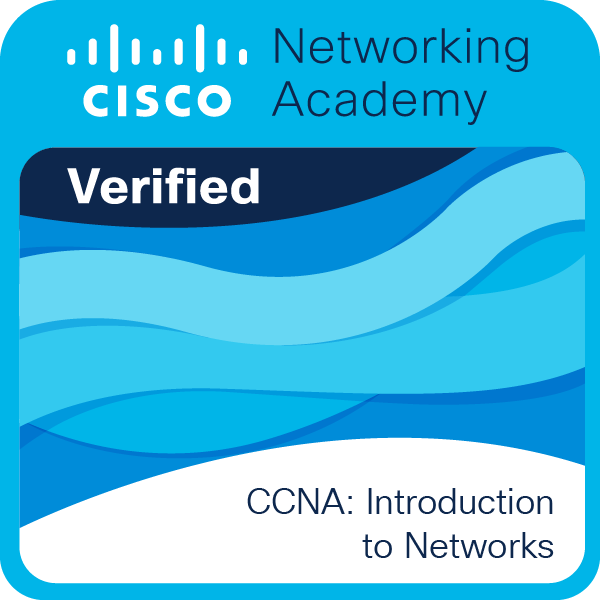
What Cisco verifies: Cisco verifies the earner of this badge successfully completed the CCNA: Introduction to Networks course and achieved this student level credential. Earner can explain how modern networks operate, configure basic Cisco router and switch settings, implement IPv4 and IPv6 addressing schemes including subnetting, apply foundational network security practices, and build and troubleshoot a small network.
[jet_fb_form form_id=”5900″ submit_type=”reload” required_mark=”*” fields_layout=”column” fields_label_tag=”div” markup_type=”div” enable_progress=”” clear=””]