


Build on your industrial networking foundations — develop specialised skills in Industrial Control Systems, Smart Grid technologies, and high-availability OT networking for the modern energy sector.
Industrial IoT and Control Systems in Energy is designed for learners who have completed Industrial Networking Essentials and want to deepen their understanding of Industrial Control Systems (ICS) and Smart Grid technologies. The course explores process automation, SCADA architectures, and regulatory compliance, as well as critical OT networking topics including high-availability networking, link redundancy, and Precision Time Protocol (PTP). The final modules focus on modern smart grids — their components, standards, architecture, and how to simulate and operate a Smart Grid network using Cisco Packet Tracer. Hands-on practice includes 14 Packet Tracer activities simulating network redundancy, time synchronisation across devices, and operations on a simulated smart grid.
Curriculum Chapters
- 1. Industrial Automation and Control Systems
- Process Automation and Control Concepts
- IACS Examples
- SCADA Systems
- Manufacturing IACS
- 2. Safety and Regulatory Compliance
- Safety in the IIoT
- Regulatory Compliance
- 3. High Availability Networking for OT
- High Availability
- Link Redundancy Mechanisms
- High Availability Protocols – Layer 2
- High Availability Protocols – Layer 3
- Implementing High Availability
- 4. Time Sensitive Networking in OT
- The Importance of Time in OT Networks
- Implementing Time Sensitive Networking (PTP)
- 5. Smart Grid Energy Systems
- What is the Smart Grid?
- Smart Grid Energy Systems Use Cases
- Digital Substation Network Basics
- 6. Smart Grid Implementation
- Smart Grid Components
- Smart Grid Standards and Architecture
- Build a Simple Smart Grid Network
- Operate a Simple Smart Grid
Skills You Will Learn
Explain the fundamentals of process automation and control concepts in industrial environments. Describe SCADA architectures and IACS examples including manufacturing IACS. Explain safety requirements and regulatory compliance considerations in IIoT deployments. Implement high-availability networking for OT environments including link redundancy mechanisms and Layer 2 and Layer 3 high-availability protocols. Explain the importance of time synchronisation in OT networks and implement Precision Time Protocol (PTP) for time-sensitive networking. Explain what the Smart Grid is and describe key Smart Grid use cases and digital substation network basics. Identify Smart Grid components and standards. Build and operate a simple Smart Grid network using Cisco Packet Tracer.
Technologies Used
Cisco Packet Tracer (14 activities — Smart Grid & energy scenarios)
Precision Time Protocol (PTP)
Layer 2 & Layer 3 high-availability protocols
SCADA simulation environments
Course Details
Course Type: Instructor-led
Time: 15 Hours
Modules: 6
Labs: 15 labs & 14 Cisco Packet Tracer activities
Level: Intermediate
Prerequisites
Completion of Industrial Networking Essentials or equivalent knowledge.
Certification & Career
Career and Certification alignment: No target certification exam for this course. Upon completion, earners receive the Industrial IoT and Control Systems in Energy Cisco digital badge. The course prepares learners for roles in the electric power sector and OT networking. The recommended next course is Industrial Cybersecurity Essentials.
Achievements & Badges
Upon completion, earn a Cisco Networking Academy digital badge. Share your verified achievement on LinkedIn, your CV, or professional profile.
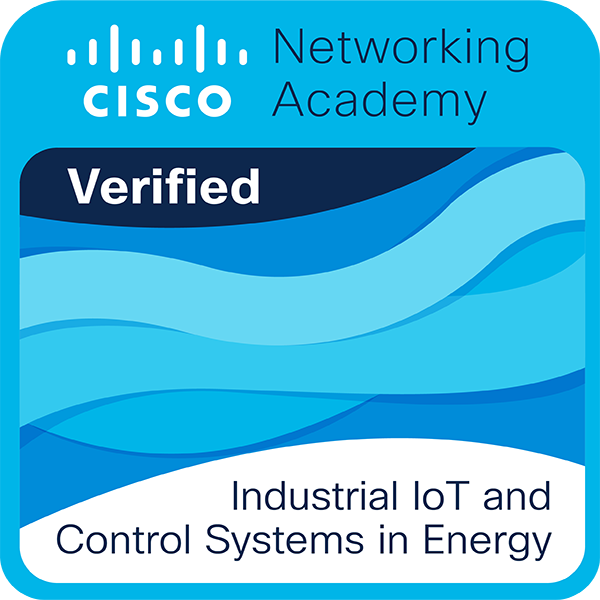
What Cisco verifies: Cisco verifies the earner of this badge successfully completed the Industrial IoT and Control Systems in Energy course. The holder of this credential has foundational knowledge of Industrial Control Systems (ICS) and Smart Grid technologies, including process automation, SCADA architectures, high-availability OT networking, time-sensitive networking, and Smart Grid implementation using Cisco Packet Tracer.